
The Growth Challenge for Established SMEs
For established small-and-medium enterprises (SMEs) with operational processes, scaling operations is a major challenge. As a business expands its client base and service range, the volume of backend transactions, database syncs, client records, and inventory updates grows rapidly. Many SMEs attempt to manage this growth by adding administrative headcount or relying on manual spreadsheet coordination. However, this manual model is inefficient and difficult to sustain. As transaction volume increases, processing delays occur, errors multiply, and operational margins shrink. This is the scaling wall that limits business growth.
To overcome this challenge and enable sustainable business growth, SMEs must replace manual workflows with business automation solutions. Rather than trying to change their core business model, firms should focus on process optimization—auditing current workflows, identifying administrative bottlenecks, and deploying custom systems. This strategic approach allows businesses to scale their transaction capacity, lower operational costs, and improve customer experiences without adding expensive administrative overhead.
The Risks of Fragile Low-Code Wrappers
When seeking business automation solutions, many SMEs look to generic, low-code “wrappers” or automated tools that promise instant, no-code integrations. While these tools can be simple to set up for basic tasks, they often lack the security, custom logic, and reliability needed for enterprise-grade operations. Generic templates are built on public networks, exposing sensitive company records, client database queries, and internal transaction logs to third-party data harvesting risks.
Furthermore, generic wrappers are structurally fragile. They are incapable of writing custom database query loops, evaluating complex conditional branches, or synchronizing bespoke enterprise resource planning (ERP) systems. When a public API changes or a transaction volume spikes, these basic integrations often break, resulting in lost data and system downtime. To build a resilient operational foundation, SMEs must avoid generic wrappers and partner with a business automation consultancy that engineers custom, containerized, and secure middleware pipelines.
Comparing Custom Architecture to Low-Code Tools
- Security: Custom containerized networks vs. public data sharing.
- Logic Capacity: Complex database loops vs. simple linear tasks.
- Integration: Seamless ERP database connections vs. rigid templates.
- System Stability: Hardened API endpoints vs. fragile connections.
A Staged Roadmap for Digital Transformation
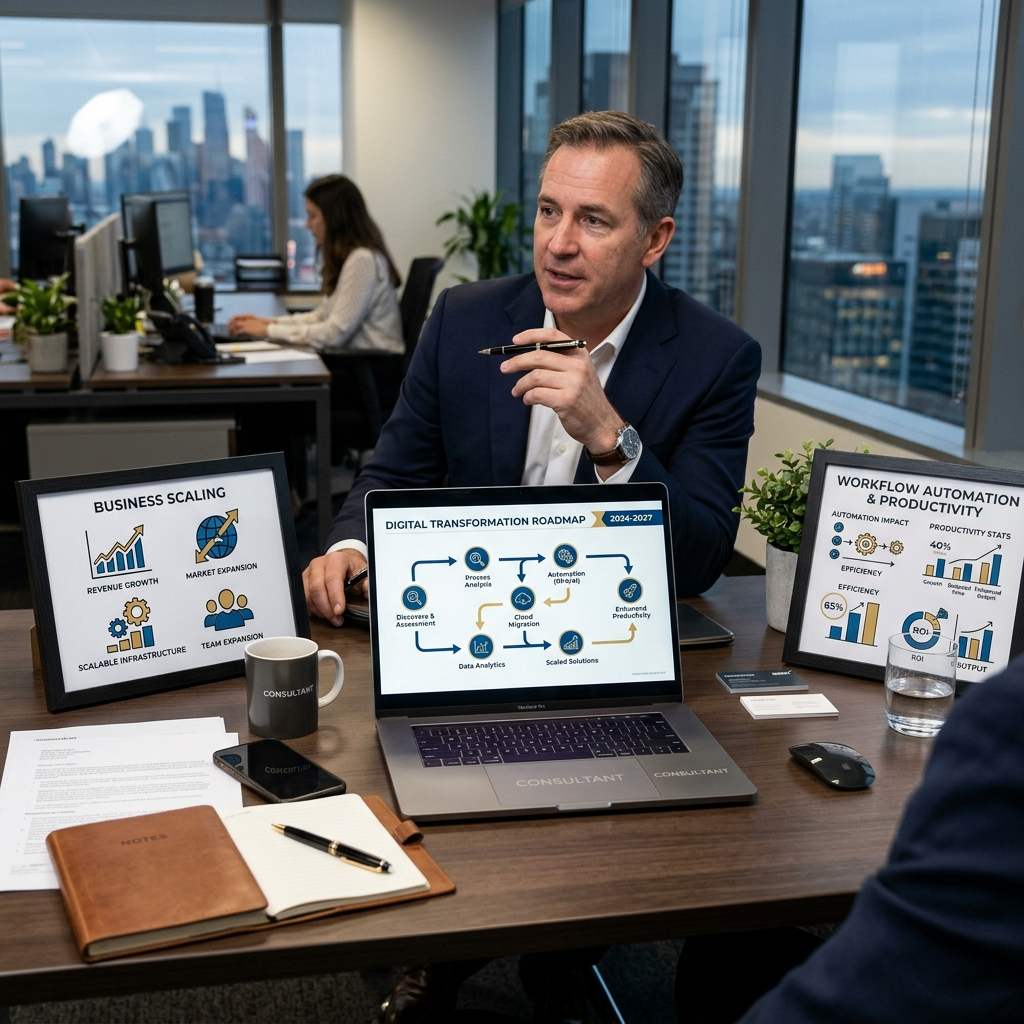
Implementing business automation requires a systematic, structured roadmap to ensure success and maintain daily operations. At Kadronix, we follow a staged consulting framework designed to analyze, architect, validate, and deploy secure automation systems for our clients. This methodology reduces risk and ensures that new integrations are fully compatible with your existing business structure.
The roadmap begins with an operational process audit. Our consultants work with your team to document your exact workflows, record transaction speeds, and locate data friction. We then design custom process logic, mapping API pathways and establishing security boundaries. Before any system goes live, we build a private testing sandbox. This sandbox allows your staff to test the automation pipeline, verify accuracy, and handle edge cases without affecting live databases. Once validated, the system is rolled out in stages, with our team monitoring performance logs to ensure stability.
Measurable Business Benefits and Efficiency Gains
A custom-configured automation pipeline delivers measurable business benefits. By replacing manual entry loops, firms save time, lower operational costs, and increase employee productivity. Back-office staff can shift from repetitive data copying to strategic, high-value tasks, improving team performance and business focus. This efficiency gain translates directly to higher operational margins and increased profitability.
Additionally, automation supports smarter business decisions. By syncing databases in real time, managers gain access to accurate, up-to-date business metrics, enabling them to identify trends and track performance. This transparency helps SMEs respond quickly to changes, optimize resources, and plan growth with confidence. Ultimately, custom process automation builds a scalable, resilient foundation, allowing your business to handle higher transaction volumes while maintaining service quality.
Primary Operations Metrics for Growth
An SME evaluating automation should track direct cost reductions, staff time savings, and transaction processing speeds. By reducing manual processing time, businesses build a foundation for long-term growth and high performance.
Building Strategic Partnerships for Long-Term Success
At Kadronix, we do not simply sell automation software; we build long-term strategic partnerships. We understand that operational requirements change as businesses grow. Our consultants provide ongoing support, refining database indexes, updating system integrations, and auditing workflows to ensure continuous performance tuning. This long-term commitment helps established SMEs maintain high operational standards and achieve sustainable business growth.
In a competitive market, operational excellence is a major differentiator. By investing in custom business process automation, established SMEs can build a scalable, secure, and modern structure that supports long-term success. Contact Kadronix today to book a discovery session and begin your digital transformation journey.