
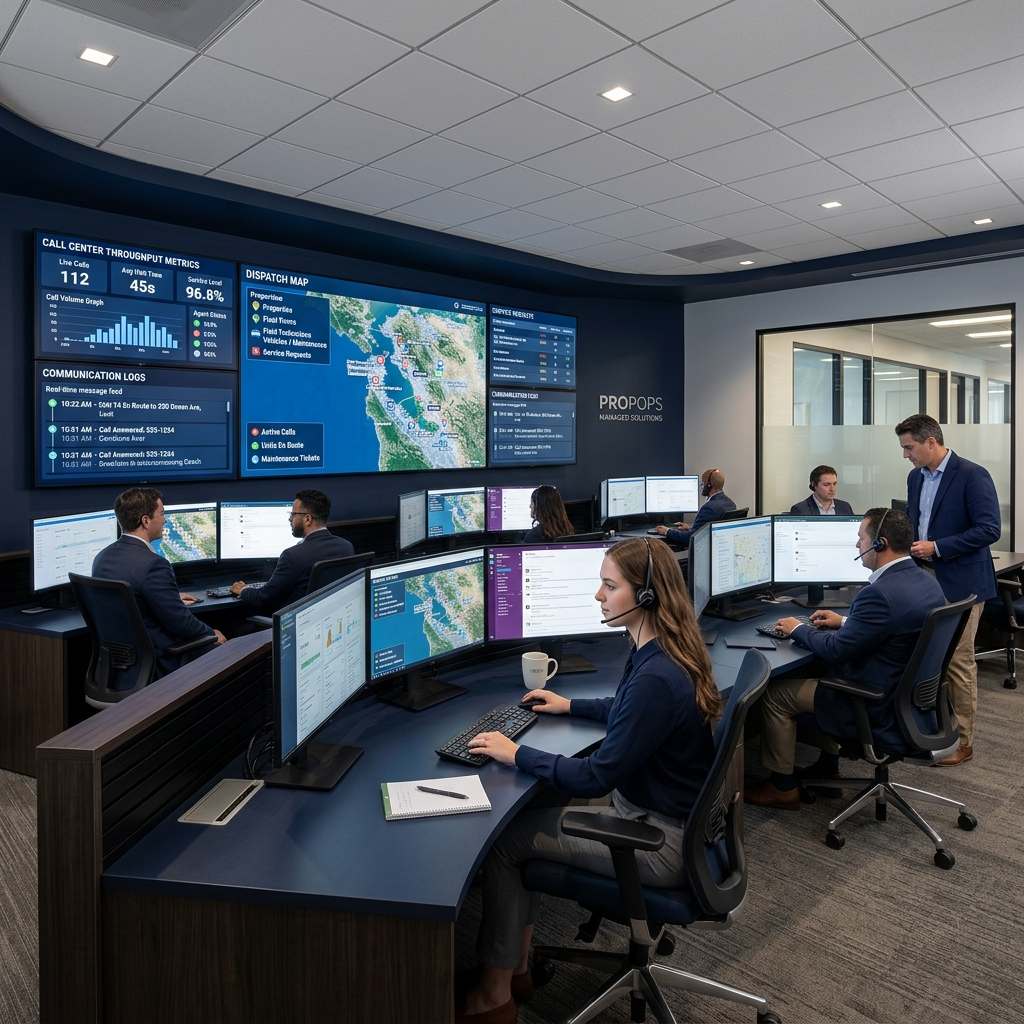
Intake and Response Challenges in Facilities Management
In property and facilities management, operational efficiency is defined by response times. Managing residential or commercial portfolios involves coordinating constant customer inquiries, tenant maintenance reports, emergency repair requests, and contractor dispatch routines. Every incoming call or message represents a time-sensitive logistical challenge. A delayed response to a major maintenance issue can lead to property damage, tenant dissatisfaction, lease cancellations, and increased repair costs. Traditional operations rely on manual telephone intake, paper dispatch logs, and office coordinators. This model is slow, expensive, and difficult to scale during peak hours.
To maintain high service standards, property management firms must manage a constant volume of inquiries while minimizing operational overhead. During peak times or out-of-hours emergencies, administrative staff can easily become overwhelmed, leading to delayed routing and missed details. By deploying intelligent voice answering systems, facilities managers can automate call routing, validate maintenance issues, and dispatch contractors instantly 24/7. This transition from manual coordination to intelligent automation reduces costs, speeds up resolution times, and improves the overall tenant experience.
The Operational Drain of Manual Call Routing
The traditional intake process in property management is highly manual and prone to delays. When a tenant calls to report a maintenance issue, an administrator must manually record the property details, determine the severity of the problem, locate an available contractor with the right skills, and coordinate the dispatch via phone or email. This manual routing is not only time-consuming but also creates operational silos. Information is often locked in spreadsheets, leading to double-entry errors and delayed follow-ups.
Furthermore, manual intake cannot scale dynamically. If a large storm causes a surge in maintenance reports, the queue of incoming calls grows rapidly, leaving tenants waiting. Out-of-hours coverage requires expensive third-party call centers that often lack the local context needed to route emergencies correctly. By analyzing these operational bottlenecks, facilities managers can locate key inefficiencies and build automated pipelines that process caller intent, verify location data, and log issues directly into their database.
Logistical Bottlenecks in Manual Property Operations
- Intake Latency: Waiting in phone queues or delays in checking email requests.
- Inconsistent Logging: Missing details or incorrect property addresses recorded by staff.
- Contractor Delay: Manually searching for and calling contractors during emergencies.
- Status Tracking: No real-time updates for tenants on repair schedules.
Intelligent Voice Answering: Bypassing Legacy Systems
To solve the intake challenge, property managers need responsive, natural communication tools that operate without delays. Simple interactive voice response (IVR) systems—the typical “press 1 for maintenance” menu trees—often frustrate callers and fail to collect the detailed information needed for dispatch. Intelligent voice automation pipelines bypass these legacy limitations by using natural language processing (NLP) to understand tenant intent and engage in structured conversation.
Our custom voice integration systems execute responses with sub-second latency, allowing tenants to speak naturally as if talking to an office coordinator. The system automatically prompts the caller for key details: property address, specific issue, and access instructions. It then parses this spoken data, cross-references it with the database, and creates a prioritized work order. By using secure APIs, the system can instantly dispatch a contractor via SMS or email, reducing the time from call receipt to contractor dispatch from hours to minutes.
Calculating the ROI of Voice Automation
Implementing intelligent voice answering systems offers measurable financial returns. The primary return on investment comes from direct operational cost reductions. By automating the initial intake and contractor dispatch of high-frequency, low-complexity maintenance issues (such as heating repairs or appliance faults), property management firms can reduce coordinator workload by up to 60%. This allows teams to focus on complex projects, tenant relationships, and portfolio expansion.
In addition, automated dispatch prevents costly delays. By immediately identifying high-priority emergencies (such as active water leaks or electrical hazards) and routing them to on-call contractors, firms can prevent extensive property damage. Calculating the cost savings from prevented water damage or structural repairs reveals the immense value of rapid, automated response profiles. Furthermore, out-of-hours coverage costs are dramatically reduced, as the automated system handles incoming emergency calls without requiring round-the-clock shift staff.
Primary Financial ROI Indicators
A facilities manager evaluating voice automation systems should focus on direct labor savings, contractor response speed, and emergency mitigation. By reducing manual call times and enabling rapid dispatch, firms see significant improvements in operational margins and client retention.
Integration Playbook: Connecting Voice and Dispatch
An intelligent voice answering system must be integrated with your core database to deliver maximum value. We design custom middleware that connects incoming voice channels directly to your property management software, CRM, and ticketing databases. This ensures that every call is logged and every dispatch is recorded in a centralized system of record:
- Tenant Calls: The voice assistant answers, validates the property, and records the request.
- Data Parsing: The middleware extracts location, priority, and maintenance category details.
- Database Update: The system automatically logs a ticket in the property management CRM.
- Contractor Sync: An API call checks database availability and routes the work order to the assigned contractor.
- Tenant Alert: The tenant receives a confirmation text containing the contractor’s arrival estimate.
This integration playbook ensures that property managers have complete visibility over all active work orders, contractor schedules, and resolution times. Information is updated in real time, eliminating double-entry and ensuring complete transparency for property owners and tenants alike.
Enhancing Tenant Retention and Portfolio Value
Ultimately, the value of facilities automation lies in tenant satisfaction and retention. Tenants expect fast, professional, and reliable communication when reporting issues. By resolving maintenance requests quickly, property management companies build trust and encourage long-term tenancies. This stability increases rental yield, reduces portfolio vacancy rates, and raises asset value, supporting sustainable business growth.